
Designing scalable AI architecture with Azure and AWS requires making the right architectural decisions under uncertainty.
It’s making the right architectural decisions under uncertainty.
This was exactly the case with DelVoice, an AI-powered clinical documentation platform designed to reduce manual workload for healthcare professionals. While the idea was straightforward, the path to a scalable, production-ready system was not.
This case study explores how we approached enterprise AI architecture using Azure and AWS, how we navigated early uncertainty, and how the system is evolving toward a more scalable and cost-efficient architecture aligned with long-term product viability.
Live Demo
You can explore example scenarios of the DelVoice platform here:
https://delvoice.com/delvoice-demo-library-transcription-soap-summary/
The page includes two sample scenarios demonstrating:
Voice conversations between a doctor and a patient
Generated transcripts from those conversations
AI-generated SOAP summaries
Structured clinical documentation output
These examples provide a practical view of how the system processes real-world inputs and generates structured outputs.
If you are interested in a live demo, please contact us to schedule a session tailored to your needs.
Designing Scalable AI Architecture with Azure and AWS in Practice
The Problem: Automating Clinical Documentation with AI
Healthcare professionals spend a significant portion of their time generating clinical notes, summaries, and reports. This process is repetitive, time-consuming, and prone to inconsistency.
DelVoice was designed as an AI-powered system to:
- Transcribe clinical conversations
- Generate structured summaries
- Produce compliant medical documentation
From a system design perspective, this required combining:
- Speech-to-text processing
- Natural language understanding
- Structured document generation
- Integration with enterprise workflows
This is not just an AI problem, it is an enterprise AI architecture problem.
Initial Technical Uncertainty in AI System Design
At the start of the project, several critical uncertainties made it impossible to define a final architecture upfront:
- Could AI models generate accurate and structured medical documentation reliably?
- How consistent would outputs be across different inputs and scenarios?
- Could we enforce formatting and compliance requirements programmatically?
- Would latency meet real-world usability expectations?
- Could an API-based AI approach remain cost-effective at scale?
Unlike traditional deterministic systems, AI systems introduce variability. This creates challenges in predictability, validation, and control, especially in enterprise environments.
This uncertainty was not theoretical, it directly impacted architectural decisions.
Phase 1: Rapid Development Using Managed AI Services (Azure & AWS)
To address these unknowns, we made a deliberate architectural decision:
Prioritize speed of validation over long-term optimization.
The first version of DelVoice was built using:
- Microsoft Azure services for backend and transcription
- AWS AI services for generating structured summaries with controllable accuracy
- API-based AI engines (including OpenAI-based models)
- Modular cloud-native architecture
This allowed us to rapidly test the core assumptions of the system.
Version 1 Architecture: API-Driven AI Platform
The initial architecture followed a streamlined AI integration pattern:
- User input (audio)
- Transcription using Microsoft services
- Processing via backend (.NET Core / Azure)
- AI-based summarization using AWS AI services
- Structured output generation
- User review and finalization
Architecture Diagram (Version 1)
Figure 1. DelVoice Version 1 architecture using Azure backend, Microsoft transcription services, and AWS AI summarization.

Real System Example
Figure 2. DelVoice transcription interface demonstrating real-time conversation capture and processing using Microsoft transcription services.
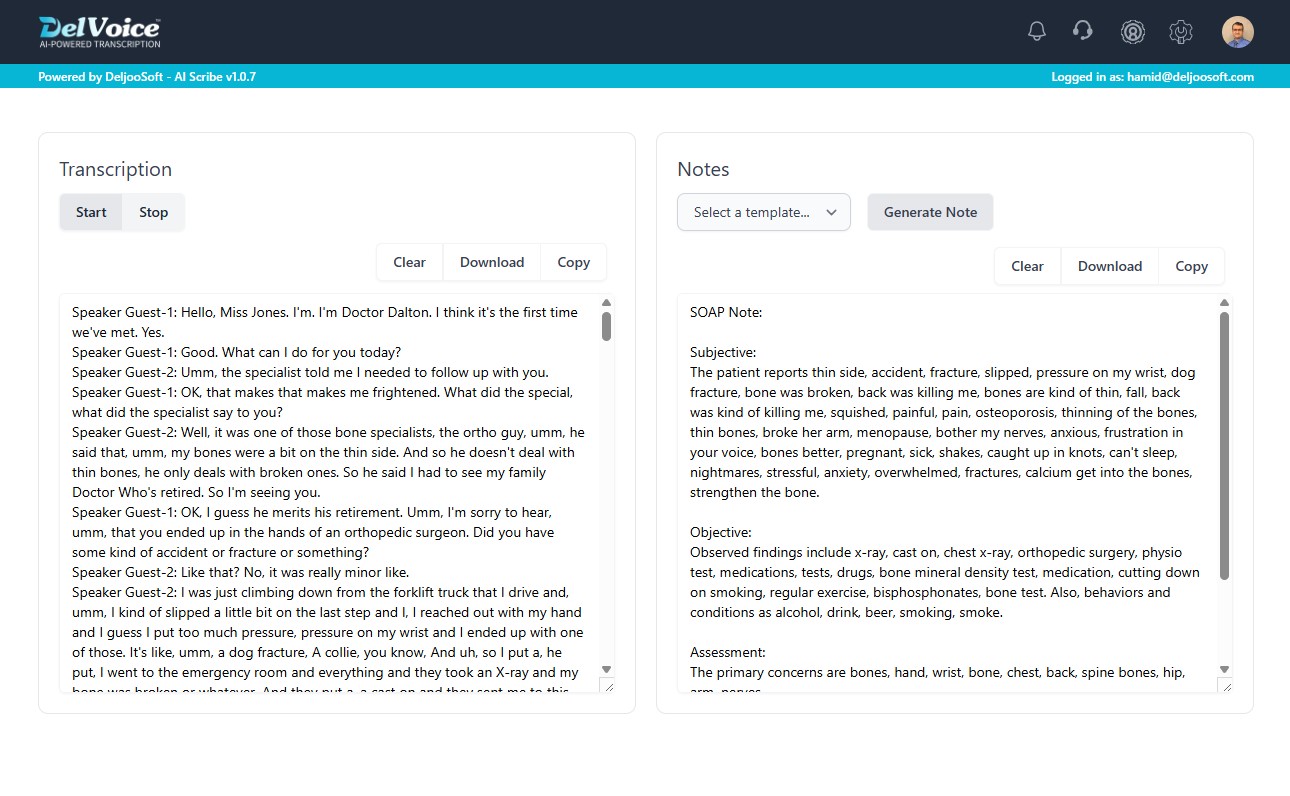
This interface represents the first stage of the pipeline, where clinical conversations are captured and processed in real time. The output of this step feeds directly into the AI summarization workflow, highlighting how frontend experience and backend AI processing are tightly integrated in the overall system design.
What Worked: Strengths of Managed AI Architecture
Using Azure and AWS AI services provided several advantages:
Speed to Market
We moved quickly from concept to working system.
Strong Baseline Performance
Modern AI APIs delivered high-quality outputs with minimal setup.
Flexibility
We could experiment with prompts, models, and workflows without infrastructure overhead.
Reduced Complexity
No need to manage training pipelines or custom model infrastructure.
For early-stage AI product development, this approach is highly effective.
Emerging Challenges: Cost, Control, and Scalability
As the system matured, several limitations became apparent.
These challenges are common in scalable AI architecture with Azure and AWS when systems rely heavily on external APIs.
Cost at Scale
API-based AI services are efficient for low to moderate usage, but costs increase significantly at scale.
Limited Architectural Control
Fine-tuning behavior, enforcing strict rules, and optimizing workflows is constrained when relying entirely on external services.
Output Variability
AI responses are not fully deterministic. Ensuring consistency requires additional layers of validation and orchestration.
Latency Considerations
Response times can vary depending on model complexity and request size.
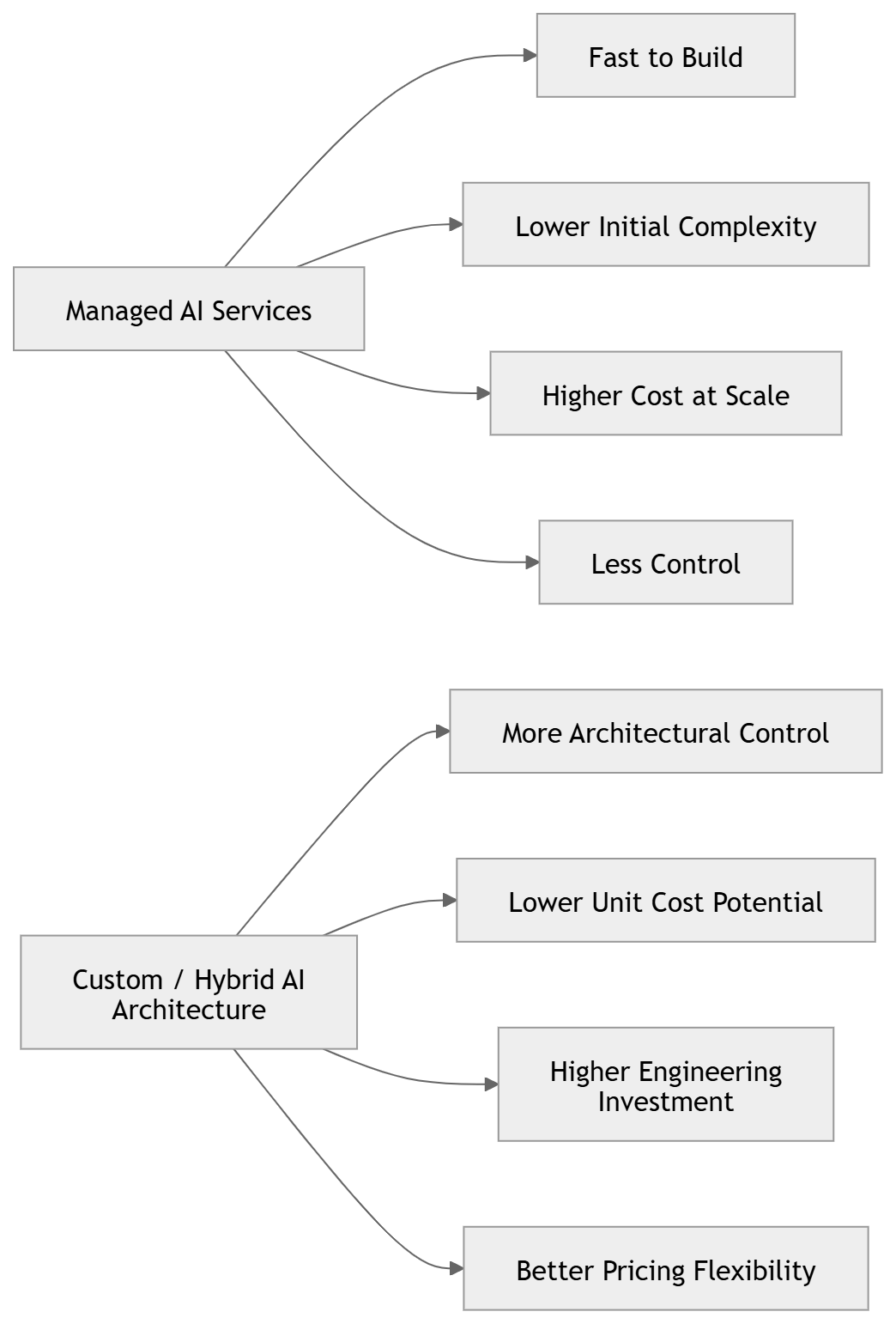
Trade-off Visualization
Figure 3. Trade-offs of API-based AI architecture in enterprise systems.
Architectural Insight: MVP vs Scalable AI Platform
A key realization from this phase was:
The architecture that enables rapid prototyping is not the architecture that supports long-term scalability and cost efficiency.
Managed AI services are ideal for:
- Proof of concept
- Early-stage product validation
- Rapid experimentation
But enterprise-grade AI systems require:
- Cost optimization strategies
- Greater control over execution
- Custom orchestration layers
Phase 2: Building an Internal AI Engine and Orchestration Layer
Based on these findings, the next phase of DelVoice focuses on developing internal intellectual property (IP) and evolving the system architecture.
This transition reflects a common pattern in scalable AI architecture with Azure and AWS, where systems evolve from API-based integration to controlled, hybrid architectures.
This approach highlights how scalable AI architecture with Azure and AWS can evolve from rapid prototyping into production-ready systems.
Evolved Architecture
Figure 4. Evolved DelVoice architecture with orchestration layer and hybrid AI approach.
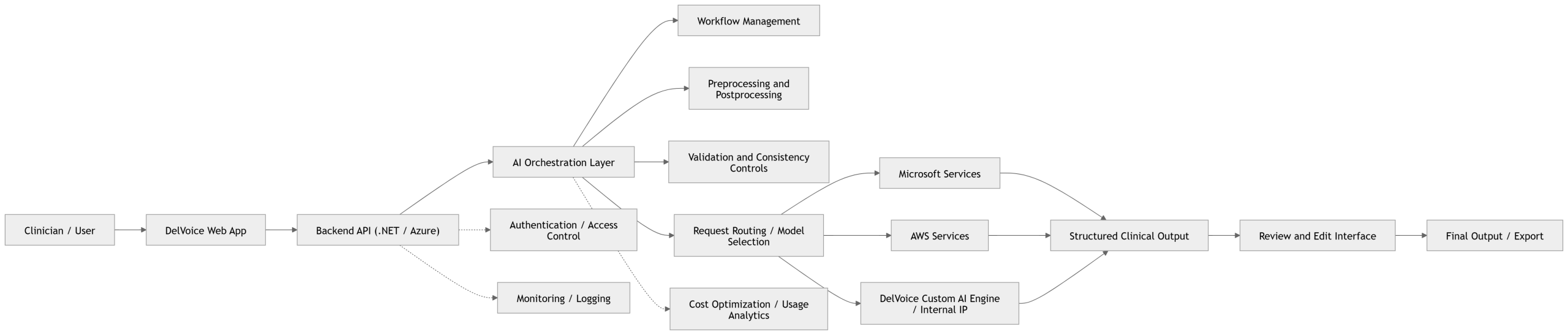
Key Enhancements
AI Orchestration Layer
- Managing AI workflows
- Routing requests across models
- Applying preprocessing and postprocessing
- Enforcing structure and consistency
Cost Optimization Strategies
- Reducing dependency on high-cost API calls
- Optimizing request structure
- Improving efficiency across workflows
Hybrid AI Architecture
- Combining Azure and AWS services with internal components
- Introducing more controlled processing paths
- Enabling competitive pricing
Custom AI Engine (DelVoice IP)
- Reducing cost per transaction
- Improving output consistency
- Increasing architectural control
This transition represents a shift from API consumption to architecture ownership.
Architectural Decision Framework
Throughout this process, architectural decisions were guided by trade-offs—not absolutes:
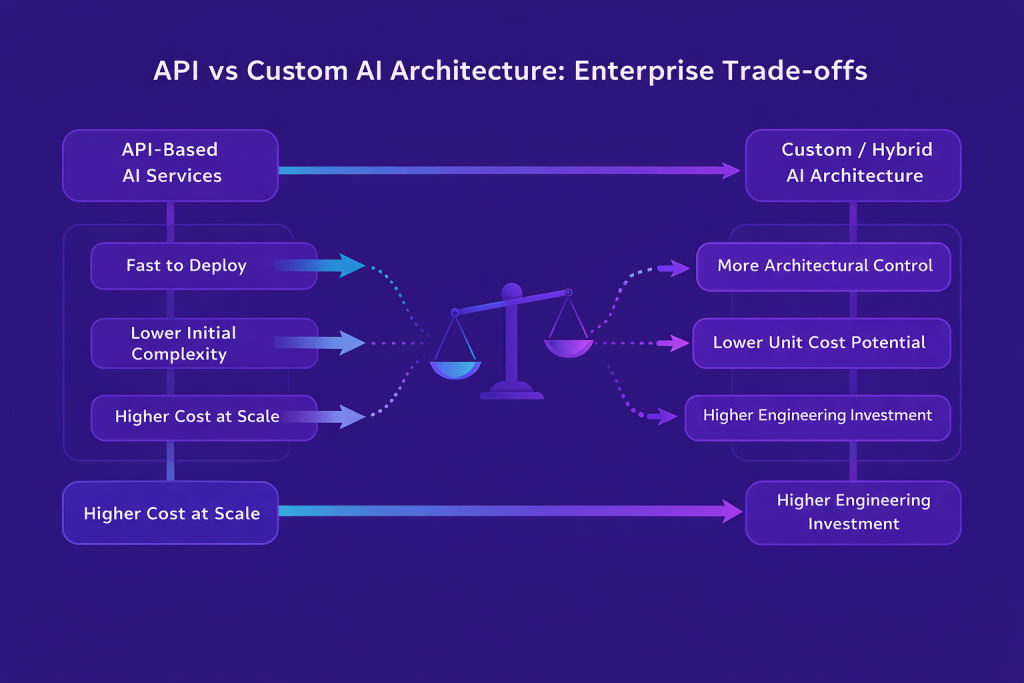
Rather than optimizing for a single dimension, the architecture evolved based on real-world constraints and learning.
This is a core principle of enterprise system architecture.
Lessons for Designing Scalable AI Systems
One of the most important lessons from DelVoice is that scalable AI architecture is not created in a single step. It evolves through staged decisions, each made with different priorities.
In the early phase, the priority was speed of validation. Using managed AI services from Microsoft and Amazon made sense because they reduced infrastructure complexity and allowed the product concept to be tested quickly.
However, once an AI application approaches production scale, cost per transaction, response consistency, workflow orchestration, and pricing competitiveness become architectural concerns.
Key principles:
- Use managed AI services to validate assumptions quickly
- Measure cost and latency early
- Treat AI variability as a system design problem
- Introduce orchestration and validation layers early
- Build internal IP when needed for control and cost
Why This Matters for AI System Design
Many teams building AI applications focus only on model capabilities.
But in real-world systems, success depends on:
- Architecture decisions
- Cost structure
- Scalability strategy
- Integration design
Using Azure OpenAI and AWS AI services is a powerful starting point, but it is not the final architecture.
Final Takeaway
DelVoice reflects a broader pattern in modern AI system design:
- Start with uncertainty
- Use managed services to validate quickly
- Learn from real-world usage
- Evolve toward a more controlled, optimized architecture
Building AI systems is not just about using powerful models.
It’s about making the right architectural decisions under uncertainty, and evolving those decisions as the system grows.
This case study demonstrates how scalable AI architecture with Azure and AWS must evolve beyond initial implementations to remain cost-effective and competitive.
Ultimately, scalable AI architecture with Azure and AWS requires balancing speed, cost, and long-term control.
Explore the System
To explore how the system behaves in real scenarios:
If you’re building or modernizing an AI-driven platform, I’d be happy to share how this approach can apply to your system.
About DeljooSoft
DeljooSoft specializes in enterprise cloud architecture, AI system design, and digital modernization, helping organizations build scalable, secure, and cost-efficient platforms using Azure, .NET, and modern cloud technologies.
You can also explore more about our approach to enterprise system design and digital modernization on our website:
👉 https://deljoosoft.com/data-and-ai-powered-solutions/